How to Protect Critical Talent In An Uncertain Labour Market
The current labour market may appear less challenging than the period immediately following the pandemic, but talent risk has not disappeared.
Organisations are no longer competing for every available candidate. Instead, they must understand where critical capability exists, where succession gaps are emerging and which employees have the skills and knowledge that will be difficult to replace.
A slower recruitment market provides an opportunity.
It gives organisations time to move beyond reactive hiring and build a more strategic approach to workforce resilience.
The organisations best positioned for the future will be those that:
Understand their critical talent
Identify potential flight risks early
Benchmark reward effectively
Build internal career pathways
Strengthen succession planning
Use workforce data alongside human insight
Flight risk management is ultimately about protecting organisational capability.
By understanding why people stay, why they may leave and where their departure would have the greatest impact, HR and Talent leaders can make better decisions today that strengthen their organisation for tomorrow.
Want to read this offline or share with a colleague? Simply fill in some details to download a copy.
Following several years of unprecedented labour market disruption, many organisations are entering a period of relative stability. Vacancy levels have fallen from their post-pandemic peak, recruitment activity has slowed, and voluntary employee turnover has eased. What was once characterised by intense competition for talent has become a far more cautious hiring environment.
For HR and Talent Acquisition leaders, this shift presents both opportunities and risks. Reduced employee movement can ease pressure on recruitment budgets and create greater workforce stability. However, it can also encourage a false sense of security.
Today’s labour market is increasingly being described as The Great Stay. Rather than actively pursuing new opportunities, many employees are choosing to remain in their current roles because of economic uncertainty, reduced hiring activity and concerns about job security. Stability, however, should not be confused with engagement.
For organisations, this creates a different type of workforce challenge. Instead of responding to high levels of voluntary turnover, the focus shifts towards identifying where critical knowledge sits, understanding which employees would be most difficult to replace and recognising potential flight risks before they become costly resignations.
This is particularly important as organisations continue to balance cost control with long-term growth. Investment in strategic workforce planning has become more important than ever, particularly where specialist skills, leadership capability or institutional knowledge are concentrated within a small number of individuals.
Flight risk should therefore be viewed as more than an employee retention issue. It is a business continuity issue that influences operational resilience, succession planning, customer relationships and future organisational performance.
As explored in our guide to succession planning, organisations often focus their planning efforts on senior leadership roles while overlooking the technical specialists, operational leaders and subject matter experts whose departure can create equally significant disruption.
This guide explores why flight risk remains a strategic priority despite a slower recruitment market, the factors influencing employee movement across different sectors, and how organisations can develop a proactive approach to identifying and reducing workforce risk.
Between 2021 and 2023, organisations across many sectors experienced unprecedented competition for talent. Vacancy levels reached record highs, employees changed jobs at increased rates, and organisations responded by increasing salaries, introducing greater flexibility and accelerating recruitment processes.
That landscape has changed considerably.
According to the Office for National Statistics (ONS), UK job vacancies have continued to decline from their 2022 peak, while unemployment has risen modestly and hiring intentions have become more cautious. At the same time, the number of applications per vacancy has increased as candidates compete for fewer available opportunities. Recruitment platforms such as Appcast report application rates reaching their highest levels for several years as organisations advertise fewer roles but receive significantly more interest from candidates.
For employers, these indicators suggest a labour market that is gradually rebalancing. For employees, they create a different calculation.
Changing jobs during periods of economic uncertainty inevitably carries greater perceived risk. Even highly capable professionals may choose to delay career moves until confidence returns, particularly where concerns exist around organisational restructuring, probation periods or future redundancy programmes.
This behavioural shift has become widely known as The Great Stay.
Unlike the Great Resignation, where employees actively sought new opportunities, today’s workforce is demonstrating greater caution. Employees are remaining with existing employers for longer, even where career progression, engagement or satisfaction may have plateaued.
Reduced employee turnover is often interpreted as evidence of improved retention. In reality, lower mobility can mask underlying dissatisfaction. Employees who remain because external opportunities are limited may still become disengaged, reduce discretionary effort or begin exploring alternative opportunities as soon as market confidence improves.
Want to read this offline or share with a colleague? Simply fill in some details to download a copy.
Periods of slower hiring often encourage organisations to shift attention away from talent retention and towards operational efficiency or cost management. While understandable, this can create unintended consequences.
Employees continue to evaluate their careers regardless of wider economic conditions. Career development, recognition, flexible working, management quality, meaningful work and competitive reward remain important drivers of engagement.
Research from the CIPD consistently shows that career progression, pay, management quality and wellbeing remain among the most significant factors influencing employee satisfaction and retention across UK organisations.
At the same time, organisations themselves are changing.
Restructures, operating model reviews, mergers, technology transformation and cost reduction programmes can all alter employee perceptions of stability and opportunity.
Individuals who previously viewed themselves as long-term employees may begin reassessing their future following organisational change, particularly where communication is limited or career pathways become unclear.
This creates an important distinction between employee retention and flight risk. Retention measures what has already happened. Flight risk attempts to understand what may happen next.
By the time turnover data reveals a problem, valuable knowledge may already have left the organisation.
While overall labour market conditions have cooled, demand for talent has not fallen evenly across every industry. Instead, recruitment activity increasingly reflects structural differences between sectors, changing technology adoption and evolving workforce demographics.
Many public-facing sectors continue to experience persistent labour shortages despite wider economic uncertainty.
Healthcare, social care, hospitality and education remain characterised by ongoing recruitment challenges driven by demographic change, increasing service demand and difficulties attracting sufficient numbers of qualified workers.
In these sectors, flight risk remains relatively visible because vacancies are difficult to fill and workforce shortages have become well established. Organisations are therefore generally more proactive in monitoring retention, workforce planning and succession.
By contrast, many office-based professions have experienced a notable slowdown in recruitment activity. Marketing, HR, finance, professional services, technology and administrative functions have all seen increased competition for vacancies as organisations become more selective in their hiring.
This has contributed to growing discussion around a so-called white-collar recession.
While the term does not describe every organisation or every profession, it reflects a noticeable shift within many knowledge-based industries where vacancy growth has slowed despite continued economic activity.
For employees, this often translates into fewer external opportunities, longer recruitment processes and increased competition for available roles.
Want to read this offline or share with a colleague? Simply fill in some details to download a copy.
Artificial intelligence is also reshaping labour demand in ways that differ significantly between occupations.
Historically, automation primarily affected repetitive manual tasks within manufacturing, logistics and administration. Now Generative AI is impacting a different category of work.
Knowledge-intensive professions such as marketing, software development, customer support, finance, legal services and HR are increasingly incorporating AI into day-to-day workflows. Rather than replacing entire professions, organisations are redesigning tasks, increasing productivity expectations and reconsidering future workforce requirements.
As Indeed Chief Economist Svenja Gudell observed in a recent conversation with McKinsey, AI is currently having a far greater impact on knowledge work than occupations requiring physical presence or interpersonal care.
For HR leaders, this presents another layer of complexity. Employees working in sectors experiencing rapid technological change may feel heightened uncertainty about future career progression, role design or long-term employability. Some will seek opportunities to develop new skills internally. Others may look externally for organisations perceived to offer greater investment in learning and innovation.
Despite slower hiring activity, it would be a mistake to assume that competition for talent has disappeared. Critical skills remain scarce.
Cyber security specialists, data scientists, experienced engineers, commercial leaders, digital transformation experts and many niche technical professionals continue to attract strong market demand.
Likewise, experienced operational leaders often possess organisation-specific knowledge that cannot easily be replaced through external recruitment.
Organisations do not need every employee to be a flight risk for the business to experience significant disruption. The departure of one highly specialised engineer, one senior programme manager or one trusted client relationship lead may create more operational risk than multiple vacancies in easier-to-recruit positions. Understanding this distinction forms the foundation of effective workforce planning.
Rather than asking, Who is most likely to leave?, organisations should first ask, Whose departure would have the greatest impact if they did?
The labour market has undoubtedly changed. Hiring has slowed, applications have increased, and employees are demonstrating greater caution when considering career moves. These conditions provide organisations with valuable breathing space after several years of intense recruitment pressure.
However, they also create the risk of complacency.
Stable headcount does not necessarily indicate a healthy workforce. Employees may remain because external opportunities have reduced rather than because they feel engaged, supported or committed to the organisation’s future.
For HR and Talent Acquisition leaders, the challenge is therefore shifting from reacting to resignations towards proactively understanding where business-critical risk exists.
The next section explores why flight risk extends far beyond employee retention, examining the financial, operational and strategic consequences of losing critical talent, and why succession planning should be considered across the organisation rather than solely within the executive team.
Want to read this offline or share with a colleague? Simply fill in some details to download a copy.
For many organisations, employee turnover is viewed primarily through a people lens. HR teams monitor resignation rates, engagement scores and employee sentiment, while Talent Acquisition teams focus on replacing roles quickly and maintaining recruitment pipelines.
However, the impact of losing critical employees extends far beyond recruitment activity.
Every departure creates a combination of visible and hidden costs. There are the immediate financial costs associated with advertising roles, agency fees, recruitment processes, onboarding and training. However, the greater impact is often less visible: lost knowledge, reduced productivity, disruption to teams and delays to strategic priorities.
This is why flight risk should be considered a business continuity issue.
A business may successfully replace an individual within a few months, but replacing the relationships, expertise and organisational knowledge they have built over years can be considerably more difficult.
Employee departures create a range of direct and indirect costs. Research frequently estimates the total cost of employee turnover at between one-half and two times an employee’s annual salary, depending on the role, seniority and complexity of replacement.
While these estimates provide useful benchmarks, the true cost of losing critical talent is often much broader. Our guide to the Cost of Recruitment explores how recruitment expenditure extends beyond the visible costs of hiring. Advertising, recruiter fees and onboarding are only part of the overall financial impact.
Organisations must also consider the productivity gap created while a role is vacant, the time managers spend supporting recruitment activity and the additional pressure placed on existing employees. For specialist or senior roles, these costs can increase significantly.
A senior technical specialist, account director or operational leader may carry years of accumulated knowledge, customer relationships or process expertise that cannot be transferred immediately to a replacement.
The impact can be considered across three areas:
The most immediate impact of losing critical talent is disruption. When experienced employees leave, organisations lose not only their output but also their ability to make decisions quickly, solve problems and support colleagues.
Potential consequences include:
Delayed projects and strategic initiatives
Increased workload for remaining team members
Longer decision-making processes
Reduced service quality
Increased pressure on managers
Loss of specialist knowledge
This is particularly significant in roles where expertise has developed over time. A new employee may have the required technical skills, but they will not immediately understand the organisation's systems, customers, culture, processes or history. That knowledge is often difficult to capture before someone leaves.
The financial consequences of employee turnover are often underestimated because many costs are distributed across different budgets.
The obvious costs include:
Recruitment advertising
External recruitment support
Interview time
Assessment processes
Background checks
Onboarding
Training and development
However, indirect costs can be considerably higher. A vacant role can affect productivity, revenue generation and team performance. Remaining employees may need to absorb additional responsibilities, increasing the risk of burnout and further turnover.
Some employees contribute value that extends beyond their individual role.
They may:
Hold specialist organisational knowledge
Lead transformation programmes
Maintain important customer relationships
Develop future leaders
Influence culture and engagement
Support succession pipelines
When these individuals leave unexpectedly, organisations may experience a strategic setback rather than simply a vacancy. This is why succession planning and flight risk management are closely connected.
As explored in our succession planning guide, effective succession planning is not limited to preparing for executive departures. It is about ensuring organisations have the capability, knowledge and leadership capacity required for future success.
A mature approach to flight risk asks: Which people would be hardest to replace, and what are we doing to protect that capability?
One of the biggest challenges in managing flight risk is identifying who is genuinely critical to the organisation.
Many businesses naturally focus on senior leaders or high-performing individuals. While these employees may represent significant risk, they are not the only people whose departure could create disruption.
Critical talent is not simply the people with the most senior titles or highest performance ratings. It includes anyone whose knowledge, skills or relationships would be difficult to replace.
Some roles are difficult to recruit because they require highly specific expertise.
Examples include:
Technical specialists
Engineers
Data and analytics professionals
Cybersecurity experts
Product specialists
Regulatory experts
Skilled operational roles
These employees may represent significant flight risk because demand for their skills remains high and external opportunities are often available.
Some employees create value because they understand how the organisation operates.
They may know:
Complex systems and processes
Historical decisions and context
Customer requirements
Internal networks
Operational workarounds
This knowledge is often developed over many years and is rarely captured fully in documentation. The risk is particularly high where only one or two individuals hold this understanding.
Employees who manage key relationships can represent significant organisational risk.
Examples include:
Major customer accounts
Strategic partnerships
Supplier relationships
Industry networks
The departure of these individuals can affect revenue, reputation and external confidence.
Future capability is also a flight risk consideration. High-potential employees who are not provided with development opportunities may become increasingly open to external approaches. This is particularly relevant where employees feel their career progression has stalled or where they believe other organisations offer clearer opportunities.
A common misconception is that flight risk management should focus only on retaining top performers. Performance is an important consideration, but it is only one factor.
An employee could be a moderate performer but still represent significant business risk if they are:
The only person with specialist knowledge
Responsible for a critical operational process
Managing a key client relationship
Supporting a major transformation programme
Equally, a high performer may have lower flight risk if they are highly engaged, have clear progression opportunities and feel valued within the organisation.
A more effective approach considers both Business criticality and Likelihood of departure. Together, these provide a clearer picture of workforce risk.
Want to read this offline or share with a colleague? Simply fill in some details to download a copy.
A simple framework can help organisations prioritise attention.
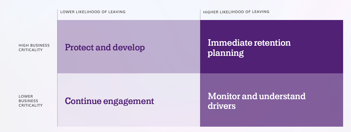
These employees require immediate attention.
Actions may include:
Career conversations
Reward review
Development opportunities
Succession planning
Increased engagement activity
These employees remain important even if they are currently engaged.
The focus should be on:
Knowledge transfer
Career development
Future succession
Continued engagement
Understanding the reasons behind potential departure remains valuable. However, investment decisions should reflect business impact.
Common factors may include:
Limited progression
Salary concerns
Poor manager relationship
Lack of flexibility
Employee movement is a natural and healthy part of any organisation. The goal of flight risk management is not to prevent every employee from leaving, but to ensure that critical capability, knowledge and relationships are protected.
A resilient organisation understands:
Which roles are business-critical
Where knowledge is concentrated
Which employees may be vulnerable to external opportunities
What actions can strengthen retention
Where succession plans are needed
By moving from reactive retention activity towards proactive workforce planning, organisations can make better decisions about where to invest their time and resources.
The next section explores how organisations can identify the warning signs of flight risk, including changes in employee behaviour, compensation concerns, career progression challenges and market factors that influence decisions to leave.
Leverage Talent Intelligence by using data-driven insights to anticipate talent needs, understand workforce capabilities, and predict future skills trends, enabling strategic decisions to meet business objectives and outpace competition.
A lack of career progression remains one of the most common reasons employees explore external opportunities. This does not necessarily mean every employee expects a promotion every year. More often, people want to understand their future within an organisation and feel that their skills, ambitions and contribution are recognised.
Flight risk can increase when employees experience:
Repeatedly missed promotion opportunities
Lack of visibility of career pathways
Limited access to development opportunities
Few opportunities to take on new responsibilities
Skills becoming outdated without investment in learning
Promises of progression that do not materialise
This is particularly relevant for high-performing employees and emerging leaders.
When individuals feel they have reached a ceiling within their current organisation, external opportunities may become more attractive, particularly if competitors offer clearer career pathways. A strong internal mobility strategy can therefore play an important role in reducing flight risk. Organisations that understand employee aspirations and create growth opportunities are better positioned to retain valuable capability.
Pay is rarely the only reason someone leaves, but organisations should not underestimate its influence.
Employees regularly benchmark their own compensation against the external market, particularly when they have specialist skills or work in areas experiencing high demand. This creates a challenge for employers.
A slower recruitment market does not necessarily mean salaries have become less important.
In fact, periods of economic uncertainty can increase sensitivity around reward. Employees may tolerate frustrations around workload, progression or recognition while external opportunities are limited, but compensation concerns can become a trigger when market conditions improve.
As explored in our guide to Salary Benchmarking, organisations need confidence that their reward approach remains competitive both internally and externally.
Effective benchmarking should consider:
Comparable roles within the organisation
Market salary ranges
Regional differences
Skills scarcity
Seniority and responsibility
Total reward package
Bonus and incentive structures
Recent research from Payscale’s 2026 Flight Risk Report highlights the complexity of this challenge. Organisations that focus only on external hiring risks may increase costs by paying market premiums to attract new employees while overlooking existing employees whose compensation has fallen behind.
Employees do not only evaluate what they are paid. They also consider whether their contribution is recognised.
Flight risk can increase where employees feel:
Their achievements go unnoticed
Additional responsibilities are not acknowledged
Exceptional performance is treated as expected
Recognition is inconsistent across teams
Reward decisions lack transparency
This can be particularly challenging for employees who consistently deliver strong results but feel that their contribution has become invisible.
For critical talent, recognition conversations should form part of regular workforce planning discussions. Retention does not always require a financial intervention. In many cases, visibility, development opportunities, meaningful projects or greater autonomy can have a significant impact on engagement. Pay is rarely the only reason someone leaves, but organisations should not underestimate its influence.
The relationship between employees and their managers remains one of the most significant influences on retention.
Poor management does not always appear as an obvious issue. It may present through:
Limited communication
Lack of feedback
Reduced trust
Poor support during periods of change
Lack of recognition
Inconsistent expectations
This is particularly important because managers often have the greatest influence over an employee’s day-to-day experience.
A strong employer brand and competitive benefits package cannot fully compensate for a poor relationship with a direct manager. For organisations assessing flight risk, manager capability should therefore be considered alongside pay, progression and workload.
High-performing employees are often at greater risk of becoming flight risks because they are frequently relied upon to manage complex or high-priority work. While this demonstrates trust, it can create unintended consequences.
Risk factors include:
Sustained periods of high workload
Multiple strategic projects running simultaneously
Increasing line management responsibility
Limited ability to take annual leave
Lack of recovery time
Expectations to continually deliver above capacity
The employees most committed to an organisation can sometimes be the ones most vulnerable to leaving if they feel their contribution is being taken for granted.
Workload should therefore be considered not only as a wellbeing issue, but as a business continuity issue. Losing an experienced employee because they have become overwhelmed creates avoidable disruption.
Periods of organisational change can significantly influence flight risk. Restructures, mergers, leadership changes and changes in strategy can all cause employees to reassess their future.
Even where change is necessary, uncertainty can create concerns about:
Job security
Future career opportunities
Changes to team structures
Shifts in organisational culture
Reduced investment in people
This is where internal communication becomes critical. Employees are more likely to remain engaged when they understand why change is happening, what it means for them and how they can contribute to the future direction of the organisation.
Poor communication during change can accelerate flight risk, particularly among employees who are already in demand externally.
Not all flight risk is driven by dissatisfaction with an organisation. Employees’ priorities naturally change over time, and personal circumstances can influence decisions about career direction, working patterns and long-term plans.
For organisations, the challenge is not to predict personal decisions, but to create enough visibility through effective workforce planning to understand where capability gaps may emerge.
Potential factors include:
Approaching retirement or planned career transition
Changes in caring responsibilities
Relocation or changes in preferred working arrangements
A desire for greater flexibility or different working patterns
A shift in personal priorities or ambitions
These factors are particularly important when they affect employees in businesscritical roles or individuals with significant organisational knowledge.
Retirement risk is often overlooked because it is predictable. However, predictability does not automatically mean preparedness.
Organisations can underestimate the amount of knowledge, customer understanding and operational experience held by long-tenured employees until succession planning becomes urgent.
Effective workforce planning should therefore include:
Identifying roles where retirement could create a capability gap
Understanding expected timelines where employees are willing to share plans
Creating knowledge transfer opportunities
Developing successors before expertise leaves the organisation
This is particularly relevant in specialist, technical and operational roles where expertise may have taken many years to develop.
The strongest flight risk assessments combine employee insight with workforce data.
Useful indicators include:
Certain points in an employee’s journey can represent moments when they reassess their future.
Examples include:
Around 18 months, when employees have established themselves and may evaluate future progression
Around three years, when employees may consider their next career move
Longer tenure points where employees may question future growth opportunities
Employees who have experienced limited change over time may become more open to external opportunities.
Potential indicators include:
More than two years without salary progression
Extended periods without promotion opportunities
Increasing responsibilities without corresponding recognition
These are not fixed rules, but useful prompts for career conversations.
Identifying flight risk is only valuable if organisations are prepared to act.
The purpose of flight risk assessment is not to create concern or encourage organisations to make reactive counteroffers every time an employee appears vulnerable. Instead, it creates a clearer understanding of where investment matters most.
The organisations best positioned to retain critical talent are those that understand their workforce, anticipate risks and create the conditions where employees can continue to grow.
The final section explores how organisations can build a proactive flight risk strategy, bringing together succession planning, salary benchmarking, talent mapping, internal mobility and workforce analytics to create a more resilient approach to talent management.
Want to read this offline or share with a colleague? Simply fill in some details to download a copy.
For many organisations, retention activity begins when an employee resigns. A resignation triggers a series of actions: an exit interview, a recruitment request, a search for replacement talent and often a review of whether anything could have been done differently.
By this point, however, the organisation has already lost valuable capability.
The employee has made their decision, knowledge transfer becomes urgent, and the business is responding to a problem rather than preventing one.
A proactive approach to flight risk takes a different perspective. Rather than waiting for employees to leave, organisations can identify where talent risk exists, understand the factors influencing retention and take targeted action to protect critical capability.
This does not mean attempting to retain every employee indefinitely. Healthy organisations need movement, fresh perspectives and new talent. The objective is not to eliminate turnover, but to ensure that departures do not create avoidable operational or strategic risk.
Effective flight risk management brings together several areas of workforce planning to create a more resilient approach to managing talent.
Once risk has been identified, organisations need evidence to understand what action may be required.
A common mistake is assuming that compensation is the primary reason employees leave. In some cases it is. In others, employees are motivated by career development, flexibility, leadership, purpose or the opportunity to work on more meaningful projects.
Understanding the underlying driver is essential.
Compensation remains an important part of the retention conversation.
Employees with scarce skills are increasingly aware of their market value and may compare their package against external opportunities.
Our guide to Salary Benchmarking highlights the importance of understanding both internal and external competitiveness.
A robust review should consider:
Are employees paid fairly compared with similar roles internally?
Are salaries competitive against the external market?
Are skills premiums recognised?
Are pay decisions consistent and transparent?
Are existing employees at risk of being paid less than new hires entering similar roles?
This final point is particularly relevant in competitive hiring markets.
Organisations that increase salaries significantly to attract new talent while failing to review existing employees may unintentionally increase retention risk among their current workforce.
Exit interviews provide valuable insight, but they happen after the decision to leave has already been made.
Stay conversations provide earlier insight.
Rather than asking employees why they left, organisations can ask current employees:
What keeps you here?
What would make you consider another opportunity?
What skills do you want to develop?
What could improve your experience?
Do you see a future for yourself here?
These conversations are particularly valuable with critical talent. They help managers understand individual motivations rather than relying solely on organisation-wide engagement data.
Not every employee requires the same intervention. A blanket retention strategy is unlikely to be effective because different people leave for different reasons. Instead, organisations should focus resources where business impact is greatest.
For high-risk, high impact employees Actions may include:
Defined progression pathways | Stretch assignments | Leadership opportunities | Skills development plans
Salary benchmarking | Recognition | Bonus structures | Benefits review
Regular career conversations | Leadership visibility | Increased recognition
Succession planning | Mentoring Documentation | Cross-training
Internal mobility is one of the most effective ways to reduce flight risk.
Employees are more likely to remain where they can see future opportunities. However, many organisations underestimate the importance of making internal career pathways visible.
Employees do not only leave because opportunities do not exist. They leave because they do not know those opportunities exist.
Organisations should consider:
Internal recruitment processes
Development programmes
Mentoring
Skills marketplaces
Cross-functional opportunities
Secondments
Creating movement internally can reduce reliance on external hiring while improving retention and employee engagement.
Rather than attempting to predict individual behaviour, organisations can assess risk using four questions.
Consider:
Impact on business operations
Specialist knowledge
Customer relationships
Revenue contribution
Difficulty of replacement
Consider:
Availability of external talent
Internal succession options
Time required to develop capability
Recruitment complexity
Consider:
Compensation competitiveness
Career development
Manager relationship
Workload
Engagement
Organisational change
Potential actions may include:
Career conversations
Salary benchmarking
Development planning
Succession mapping
Knowledge transfer
Internal mobility opportunities
Leadership support
Ultimately, managing flight risk is not about creating retention strategies in isolation. The same factors that reduce flight risk also create stronger organisations:
Clear career opportunities
Effective leadership
Competitive reward
Meaningful work
Investment in skills
Recognition and trust
Open communication
Retention is not achieved through a single initiative. It is the outcome of the everyday experience employees have within an organisation.
This is particularly important in an uncertain labour market.
When external opportunities are limited, employees may remain by default. When confidence returns, organisations that have not invested in engagement, development and workforce planning may find that their stability was temporary.
We have delivered critical talent acquisition and intelligence projects for over 150 organisations across 80 global markets.
Our work uncovers hidden talent pools and informs critical talent decisions with realtime first-person research
Common use cases include:
Supported talent acquisition through our Talent Search service.
Talent Mapping research to identify relevant candidates for specific roles.
Total reward benchmarking, encompassing benefits, responsibilities, flexibility and salary.
Location insights to guide decisions about relocations, new offices or facilities or switching to remote or hybrid working models.
Employer brand perception and EVP development.
Competitor analysis, from roles and responsibilities to organisational structure.
If you’d like to find out how we can help your organisation retain and attract critical talent, contact us here or email hello@talentinsightgroup.co.uk for a no-obligation conversation.
© Talent Insight Group 2025